
Artistic Statement
As an audience member, an artist, and a human being navigating this life, my soul is most stirred when engaged by human will and its struggle to express itself or pursue its ambitions against oppression and/or repression. Nothing is quite so compelling as the journey to find one’s own voice and then freeing that voice in an attempt to connect with one’s peers, even adversaries, and community. As someone fixated on mortality from my earliest childhood days in the well-worn Baptist pews of my great-grandparents, this struggle ties directly back to the big questions we all grapple with at one point or another: What is this human experience? What makes it valuable? What makes it livable? What makes it worth the thousand natural shocks that flesh is heir to? For me, the answer was always “to be.” The real question was “why?” While a vast majority of drama could be linked back to this existential core, I find a common pulse that ignites my creative impulse in the following eclectic collection of titles:
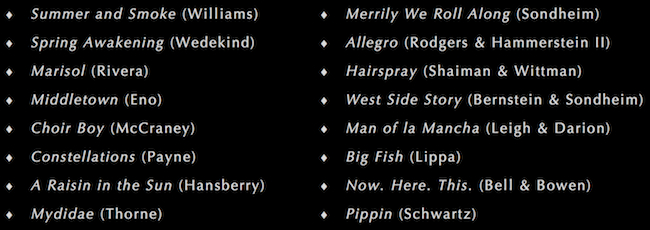
In addition to touching briefly on content to which I’m drawn, it is also worth mentioning form. Musicality is a central element to my own work as a director. I am particularly attuned to the musicality of language and the way rhythm, tempo, and usage can be expressive of and fuel for the psycho-physical actions of the characters and the overall dramatic action of the play. I find sound design to be an indispensable tool in crafting the way in which a story is told. There is also a musicality to staging, particularly evident in the work of Mary Zimmerman. The relationship of bodies in space in motion can be such an impactful storytelling tool. This holds true across forms – from the more abstracted, stylized pieces of Zimmerman or sections of John Tiffany’s work, to carefully crafted moments in the most naturalistic of plays. Back to Writing Page